We Built the Accessibility Platform We Couldn't Find
Forty years of higher education. Thirty years of building software. One mission: make every campus website legally accessible before April 2026 — without touching a single line of code.
I've been building software for thirty years. I've seen overhyped technology come and go, watched startups chase trends, and seen "AI" sprinkled on products that didn't need it. So when my co-founder Dr. Amir Dabirian — a 40-year veteran of higher education and former CIO of the entire California State University system — called me in 2023 with a problem, I wasn't looking to build another company. I was looking to solve something that actually mattered.
Amir had just chaired the CSU Accessible Technology Initiative. He'd sat in rooms full of the smartest people in campus IT, and he'd watched them struggle with the same impossible question: how do you make 3,000+ web pages and tens of thousands of documents accessible — at scale, before a federal deadline — without an army of developers?
There was no good answer. So we decided to build one.
Stat | Context |
|---|---|
51M+ accessibility errors | Across the top 1 million websites (WebAIM, 2024) |
4,000+ ADA-related lawsuits | Filed in 2024 alone |
April 24, 2026 | Federal deadline for state/local gov't & higher ed (WCAG 2.1 AA) |
The Deadline Nobody Is Ready For
On April 24, 2026, the Department of Justice's ADA Title II rule takes effect. Every state and local government entity — including all public colleges and universities — must meet WCAG 2.1 AA compliance across their digital properties. This isn't a soft guideline. This is federal law with a hard date.
Here's the reality on most campuses today: nobody knows how many pages they actually have. They don't know how many PDFs are hosted across twenty different department sites. They don't know which videos have accurate captions. And the tools they're supposed to use to fix these problems? They fall into three categories, and every single one fails at the actual job.
⚠ The Three Failing Approaches
Overlay widgets (AccessiBe, UserWay, AudioEye) inject JavaScript that screen readers parse before the overlay runs — meaning the fix never actually reaches users who need it. The FTC fined AccessiBe $1M in 2025. Scan-only tools (Siteimprove, WAVE, Deque) find violations but can't fix them. PDF-only tools (CommonLook, Equidox) cover one file type but ignore the 80%+ of your digital presence that isn't a PDF.
We spoke to CIOs at a dozen universities. The pattern was identical everywhere: they'd bought one of these tools, they had a dashboard full of red alerts, and they had no viable path to compliance by April. One CIO put it plainly: "I have a tool that tells me I have 11,000 problems. I don't have a tool that fixes them."
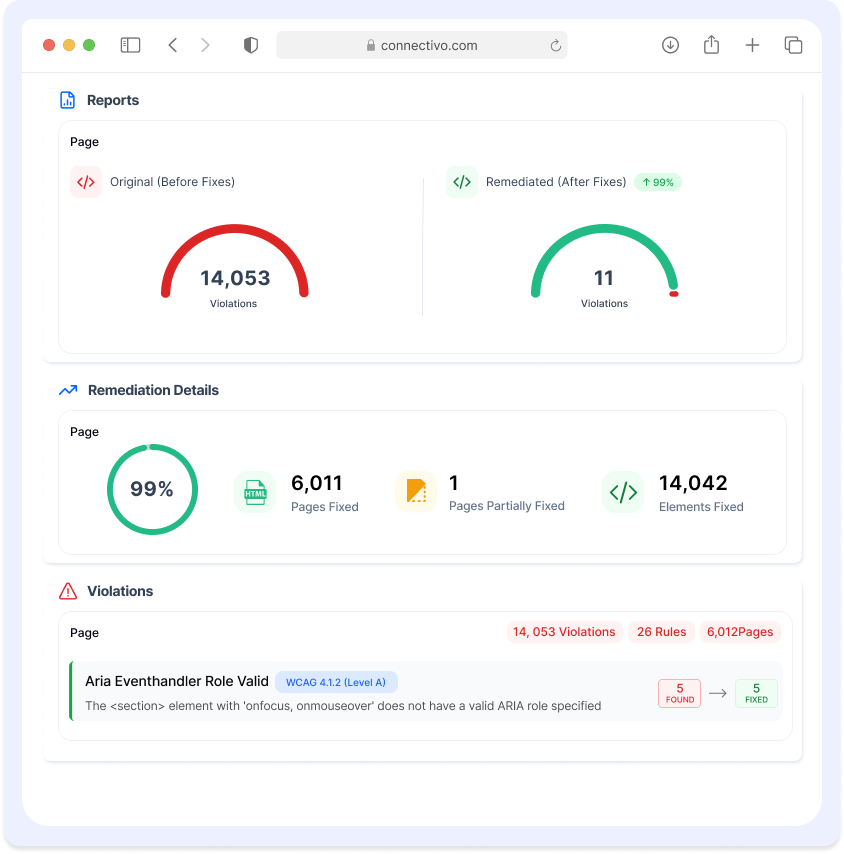
The Connectivo platform dashboard — a real-time view of your entire digital footprint: pages scanned, files inventoried, violations detected, and compliance status across your organization.
What We Built — And Why It's Different
Connectivo is an AI-powered intelligent proxy. That word — proxy — is the key to understanding why it works when everything else doesn't.
Rather than injecting JavaScript into a finished page (overlays), or scanning and leaving fixes to a developer (scan-only tools), our proxy sits between your web server and your users. When a page is requested, the proxy intercepts the HTTP response, applies pre-validated WCAG fixes in memory — in under 100 milliseconds — and delivers a fully compliant page. No source code changes. No CMS access. No developer required.
"Every other approach puts the remediation burden on your team. Ours takes it off entirely. Your developers don't need to do anything. Your CMS doesn't change. Your server doesn't know we're there."
— Farsheed Atef, Co-Founder & CTO
The proxy isn't just clever architecture. It's the only approach that can genuinely scale to a campus with 30,000 pages managed by 40 different departments — because it doesn't require 40 different departments to do anything.
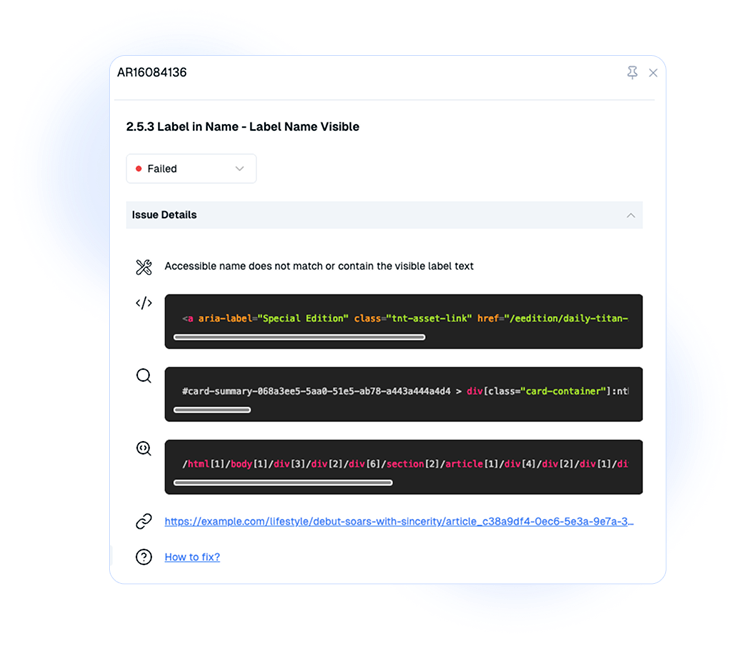
The Connectivo AI coding platform — trained on 100,000+ WCAG violations, generating precise code-level fixes validated against WCAG 2.1 AA or WCAG 2.2 AA and IBM Accessibility Checker before deployment.
How It Works in Three Phases
We designed Connectivo around the three questions every compliance officer needs answered: What do I have? Can it be fixed? Is it staying fixed?
1. Discover — Map Everything Connectivo Discover
Our crawler maps every page, PDF, form, video, and broken link across your entire domain — including subdomain sprawl that your IT team didn't know existed. A typical university crawl completes in 24–48 hours and surfaces thousands of assets that were never manually cataloged.
2. Remediate — Fix It at the Edge Connectivo AI Remediation + Proxy
Our AI coding agent — trained on over 100,000 WCAG violations — generates precise code-level fixes as reusable "remediation recipes." Each fix is validated against IBM Accessibility Checker before it's deployed. The proxy applies approved fixes in real time, at sub-100ms latency, to every page load. Web pages, PDFs, forms, and videos — all content types, one platform.
3. Monitor — Stay Compliant Connectivo Governance
Pages are constantly updated or added. Our ongoing monitoring detects regressions early, preventing violations. Leadership receives real-time compliance dashboards. Your legal and audit teams are provided with WCAG-mapped evidence reports and VPAT documentation that stand up to DOJ scrutiny — generated automatically and kept up to date.
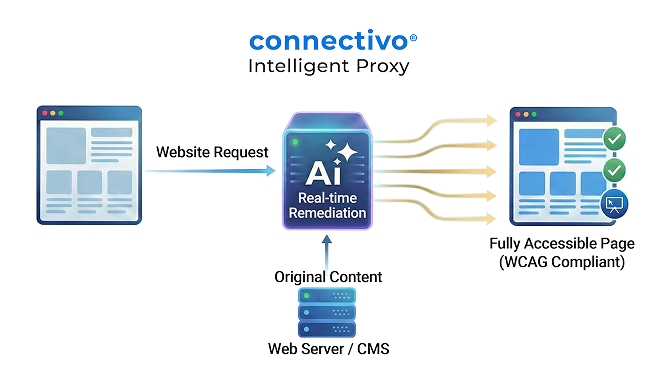
The Connectivo Intelligent Proxy — sitting between your server and your users, intercepting responses and applying pre-approved WCAG fixes in memory at sub-100ms latency. No code changes, no CMS access required.
Why We Started in Higher Education
We didn't choose higher education because it was the easiest market. We chose it because Amir spent his career working within it, and because the stakes—and the urgency—are as high as they come.
Public universities are particularly vulnerable. They have huge digital footprints (thousands of pages managed by dozens of semi-autonomous departments), limited IT resources, and a strict federal deadline that can't be extended. They also can't switch to a new CMS in twelve months or retrain every content creator in time. They need a solution that works within those constraints, not one that requires removing them.
We also chose higher education because we believe in what universities do. Every student who can't fill out a financial aid form because it isn't screen-reader friendly is a student who might miss out on the aid they deserve. Every lecture video without accurate captions is a student with hearing loss being excluded from content they paid tuition for. Accessibility isn't just a checkbox. It's a civil right.
✓ Early Traction
We're proud to share that four California State University campuses have committed to deploying Connectivo: Cal State LA, Cal State Fullerton, Cal State San Bernardino, and Cal Poly Pomona. These are among the largest public universities in the country. Their confidence in our approach is the validation that matters most to us.
What We Believe About Accessibility Tech
We want to be transparent about our philosophy, because it shapes every product decision we make.
Overlays are not a solution — they're liability. Forty-one percent of organizations that were sued for ADA violations had already deployed an overlay widget when the lawsuit was filed. The FTC has now fined AccessiBe $1 million. We have never built an overlay, and we never will.
Scanning without fixing is not progress. A compliance dashboard full of red alerts is not a compliance strategy. We built Connectivo to close the loop: discover the problem, generate the fix, deploy it, monitor the result. The whole chain, automated.
Accessibility should not require your developers. The organizations that need accessibility compliance the most — public universities, government agencies, healthcare networks — are precisely the ones with the most constrained development resources. If your accessibility solution requires a developer to implement every fix, it won't scale. Our proxy architecture means your team reviews and approves fixes; the deployment happens automatically.
Audit-ready evidence is not optional. The DOJ doesn't want to hear that you're "working on it." They want WCAG-mapped documentation showing exactly which violations existed, which fixes were applied, and when. We generate that evidence automatically, on every page, continuously.

Real-time compliance publishing — the moment a fix is approved, it goes live across your site instantly. Your users see a fully compliant page; your team never touches the code.
The Road Ahead
We're launching Connectivo publicly today with a clear focus: helping higher education and government institutions reach WCAG 2.1 AA or WCAG 2.2 AA compliance before the April 2026 deadline. After that, we're expanding to enterprise and healthcare — any organization with a complex digital footprint and real legal exposure.
We're a small team. We're pre-seed. We've been self-funded through beta because we wanted to prove the technology worked before we asked anyone else to believe in it. The CSU commitments are that proof.
If you're a CIO, VP of IT, general counsel, or accessibility coordinator at a public university, state agency, or large enterprise — and you're staring at a compliance gap you don't have a plan to close — we'd like to talk. We'll scan your site for free, show you exactly where you stand, and walk you through what a realistic remediation timeline looks like.
We don't do fear tactics. We do evidence. If the evidence shows you have a problem, we'll show you how to fix it.
Farsheed Atef is Co-Founder & CTO of Connectivo. He has 30+ years of experience as a tech entrepreneur, with two exits in AI, cybersecurity, and cloud infrastructure. Dr. Amir Dabirian is Co-Founder & CEO. He served as Provost and VP of Academic Affairs at Cal State Fullerton and as CIO of the California State University system. Together they founded Connectivo to solve the accessibility compliance problem they saw firsthand inside higher education.
Request a Free Accessibility Scan — We'll crawl your entire web presence and show you exactly what you're facing at no cost and no obligation.
April 24, 2026 deadline for ADA Title II compliance (state/local gov + higher ed)
Related Articles

Introducing Connectivo LMS - Canvas Course File Accessibility Remediation Inside Your LMS
Connectivo LMS integrates automated accessibility remediation directly within LMS platforms like Canvas. It automatically audits, fixes, and publishes accessible course materials—including PDFs, slides, documents, spreadsheets, images, and videos right in your preferred LMS.
Faculty and LMS Accessibility: How Higher Ed Can Rise to Meet April 2026
Faculty and institutions share a common goal: student success and equitable access to learning. The path forward requires the right tools, strong partnerships, and a commitment to making LMS accessibility a campus-wide priority.